Posts tonen met het label DNA U152-Z36. Alle posts tonen

zondag 14 december 2014

Novel DNA cousin with common ancestor at about 0-500 AD.

Since January 2013, it has been found that two members of the Recourt family carry a similar Y chromosome. These are Peter- and Kees Recourt, who are 8 generations separated, sharing Hendrik Recourt (5.B: 1724-1793) as a first common ancestor. As analyzed by FamilyTree DNA, only two mismatches at the STR 67 level were recorded, which predicts a 90-95% certainty of a common ancestor between 12-14 generations (source). In addition, both relatives belong to the same rare DNA haplogroup R1b-U152(Z36). These STR- and SNP DNA homologies are sufficient prove that both family members indeed have the same biological ancestor, such as predicted by the paper trail. So, we can also state that the yDNA haplogroup of the Recourt family is indeed R-Z36. Since the end of 2013, the DNA sequence of a large part of the Recourt Y chromosome is known, displaying 55 additional mutations (see blog article of Feb 2014).

Very recently, a third cousin was identified as based on DNA sequencing data of the Y chromosome. Apparently, both a descendant of Andreas Staudt (Asschaffenburg, Germany) and Theodurus de Rocourt (Liège, Belgium) have the SNP FGC6511+ incorporated in their Y chromosome. Since this DNA mutation is downstream of SNP Z36, they are more closely related than to the other R-Z36 haplogroup members. Their relationship is depicted by the orange line in the R-Z36 Google map hereafter. Using Janzen's variance model, a first common ancestor is estimated at about 0-500 AD.


Z36+ in Europe weergeven op een grotere kaart


You may also find the novel subhaplogroup at the second page of the FTDNA - U152 results group (U152>Z36>FGC6511+, snapshot hereafter).


Option 1:  settling of Franks in the Liège area?

Based on these novel results, it may have been that the ancestors of the Rocourt family migrated from Germany to Belgium somewhere around 500 AD. During this time, there were major migrations of the Franks at the end of the Roman Empire period. As cited from this website describing the history of Liège:

"...it was the settling of the Franks in this part of Belgium, in the 2nd century that placed the area around Liege firmly at the centre of European history. These Germanic tribes-people were settled in modern-day Wallonia by the Romans, to help defend the empire's northern border. They did this well, and they became thoroughly Romanized, speaking Latin and living in villas – long after the Roman empire was eventually swept away in the 5th century. Their German-tinged Latin would eventually become modern-day French. And one of these Frankish villas, on the banks of the Meuse, became the scene of the murder of a certain Lambert, the bishop of Maastricht, in 700."

In addition, please also review Eupedia.com on the migration and history of the Franks.


Option 2:  the Celtic Helvetii as Roman subjects?

It may also be that part of the Z36 haplogroup -including the Rocourt family- are direct descendants of the Swiss Helvetti tribe. After being defeated by the Romans, there may have been migrations into the Roman Empire especially to the border areas. Further reading.

Clearly, more evidence is accumulating that the Z36 haplogroup has proliferated in the Alp region after which several migrations have occurred.
  

dinsdag 18 februari 2014

Detailed Y chromosome DNA sequencing data.

In 2013, a major part of the Recourt Y chromosome has been sequenced by the US company Full Genome Corporation (ref.1). This analysis revealed 59 additional DNA mutations, from which a number may be shared by DNA cousins. If so, these 'private' mutations will be earmarked as SNPs (Single Nucleotide Polymorphisms), characterizing subhaplogroups downstream of Z36. The physical location of SNP Z36 which is about 4000 years old, can be found at the most recent ISOGG YDNA SNP index map (ref.2 & 7).  The position of additional downstream Recourt mutations at the Y chromosome, their characteristics and the respective names are summarized hereafter.


The physical locations of the DNA mutations at the Y chromosome are statistically shown hereafter.


More and more Z36 individuals are tested for their Y chromosome DNA sequences and recently it has been shown that SNP FGC6511+ is also found in another R-Z36 individual (see blog article Dec. 2014).

Please also review recent developments at the Anthrogenica forum and the developing R-Z36 tree at the Yfull community and especially at the FT DNA U152 page (refs 5 & 8). The ID of the Recourt Y chromosome is YF01743 and FGC-LXS7L. The DNA Phylogeny is more and more based on Y chromosomal DNA sequence data.


References

(1) https://www.fullgenomes.com/

(2) http://www.isogg.org/tree/ISOGG_YDNA_SNP_Index.html

(3) SNP mutation rate of approx. 1 - 2.5 * 10(-8) Mbp per generation.
or 4 * 10-8 per nucleotide per generation equals 1 SNP per 25 Mbp per generation.

(4) Fluxus Engineering (website).

(5) Family Tree DNA R-U152 and Subclades Research Project (Results page).

(6) List of STR markers, Wikipedia.

(7) Both Fluxus -and STR variance analysis suggest that the age of Z36 is about 4000-4500 yrs. This may mean that each recorded Y DNA mutation (55) represents about 70-80 yrs. The latter period may correspond with one novel point mutation per 3 generations. (1 generation about 25 years).

(8) http://www.yfull.com


zondag 20 januari 2013

Recourt Y-chromosome validated!

The Y-chromosome of the Recourt family has been validated! Now, two family members -Peter and Kees Recourt- who are 8 generations separated sharing Hendrik Recourt (5.B: 1724-1793) as a first common ancestor, display similar y-chromosome markers. As analyzed by FamilyTree DNA, only one mismatch at the STR 37 level was recorded, which predicts a 90-95% certainty of a common ancestor between 8-10 generations (source). Further analysis is underway, but already now it is quite certain that the R1b-U152(Z36) haplogroup is indeed the origin of the Recourt ancestors.

The Phylogenetic relationships of haplogroup Z36 were further investigated using the Fluxus Engineering software at the RM-MJ mode with MP post processing. In total, 44 haplogroup members are included using the Tibor Fehér STR markers and the FamilyTreeDNA data.

Based on this method, the Z36 cluster has a common forefather at about 2000 BC using the central Swiss-German cluster as the ancestor node. The Recourt Y-chromosome (195362, light blue) appears related to the green Italian haplogroup members. The common ancestor of members 42313 (ancestor), N62602, N52629, 199556, 195362, 118710, E10249 and E14605 is about 500 BC. This possible relationship is discussed in more detail at the English part of the website.

To further validate the presumed family relationships, we are currently searching for Flemish Roucourt and Walloon Rocour(t) family members (Liège area) willing to perform a (free) Y-chromosomal DNA analysis.

dinsdag 27 december 2011

Draft phylogenetic tree of Y-DNA SNP Z36 and possible route of ancestors.

Addition January 21 2012:

Today, I received very nice Phylogenetic tree network results using free fluxus engineering software as made by Tibor Fehér, one of the administrators of the Family Tree U152 project. His tree is shown hereafter:


I was able to reproduce his results by using the free software (except for the nice layout). My compliments for his work! According to this network analyses, my STR markers (blue spot) appear more related to the Italian members (green) than the Britisch Isles members (yellow). So, a fair chance exists being positive for the Z36 downstream SNPs. Also Z36 is now estimated 3900 years old (+/- 700 years), which is much older as determined using Tim Janzens method.

These results put the previous blog in a different perspective ... (read hereafter), but partly may still be of interest so I will not delete it.

------------
------------

While investigating the y chromosomal STR Dys values of Z36+ cousins, I attempted to create a phylogenetic tree of the respective members (source Family Tree DNA R-U152 project). Before doing so, the mosty likely ancestor DNA was postulated, (average of all members) and then deviations were recorded. Although the TMRCA of the complete Z36 group seems about 825 BC, while varying the subgroups, the common ancestor appears to be older (1150 BC).

Apparantly, some STR markers correlate with specific groups. Such as Dys 389-2, which has 29 repeat sequences for most members, but is 30 for the Czech and Hungarian - and 31 for the Scottish group. Other discriminating Dys regions include 389-1, 458 and 481. Part of the draft results are shown hereafter but you can also review the weblink.


Draft Phylogenetic Tree using STR Dys values as published by Family Tree DNA. Top row: STR markers. Second row: published mutation frequencies as expressed in generations. Third row, postulated Dys values of common ancestor (number of repeats of specific STRs). Green numbers: similar to ancestor. Yellow numbers: Dys values +/- 1. Red numbers: Dys values +/- 2 or more as compared to ancestor. Dates AD or BC: postulated date common ancestor using Janzens TMRCA spreadsheet. 

Interestingly, my Dys values appear to match the best with a descendant of Laurence Strang, who lived at the Shetland Islands (1680). When using the TMRCA calculations, a common ancestor at 500 AD is predicted. Of course, the most obvious route is from Germany to Belgium crossing the Canal to the UK and then up North. However, since no Z36+ members are found in the Southern part of the UK yet, I currently favour an alternative route: from Germany to Denmark/Norway? and then to Scotland/Shetland Isles and to Northern France/Belgium. This idea needs validation by finding Z36+ members from Scandinavia and by finding matches with downstream (Scottish) SNPs. The current 4 Danish members all belong to L2+, which is a different U152 subclass.


You may find the Google Z36+ map here. Is the Recourt family descending from a Celtic tribe in Denmark, which became a subpopulation of the Vikings? Scandinavian settlements dating from the 9-10th century are found in Normandy, but also at the Shetland Isles, Scotland, Ireland and England.


Sources:
http://en.wikipedia.org/wiki/Viking
http://en.wikipedia.org/wiki/Viking_expansion
http://en.wikipedia.org/wiki/Scandinavian_Scotland
See also:  http://www.davidkfaux.org/Cimbri-Chronology.pdf

These developments may also shed light on the "Recent Ancestral Origins" data, which is a service of Family Tree DNA. A graph displaying the percentage of exact 12 markers matches for each region is shown hereafter (update 20 november 2012).


Clearly, the proposed homeland region Switserland displays the highest percentage of 12/12 matches, followed by Scotland, Northern Ireland and Wales. These latter regions are believed to be populated with a relative high percentage of remaining Celtic descendants.

And tonight, the first Z36 meeting was held to discuss recent developments. A kind of family reunion :)


On the right: Gerard, descendant of Peter Hugenholdt (Germany) and on the left Kees, descendant of Dirk van Roucourt (Belgium). We found out that we live very close to each other and even share friends.   

***

maandag 19 september 2011

R-U152 in the low countries

Recently, the second book on the Belgium DNA project has been published (ref 1). In total, 881 males were analysed at the Y-chromosomal level, which is a major achievement for an area less than 100 square miles (see also ref 2). About 10% (90) of the predominantly Flanders population analysed appear R-U152 positive and thus may have its roots in the Hallstatt or La Tène culture (proto-Celtic). Whether “star” or “plus” remains to determined, since no further subclading has been performed yet.


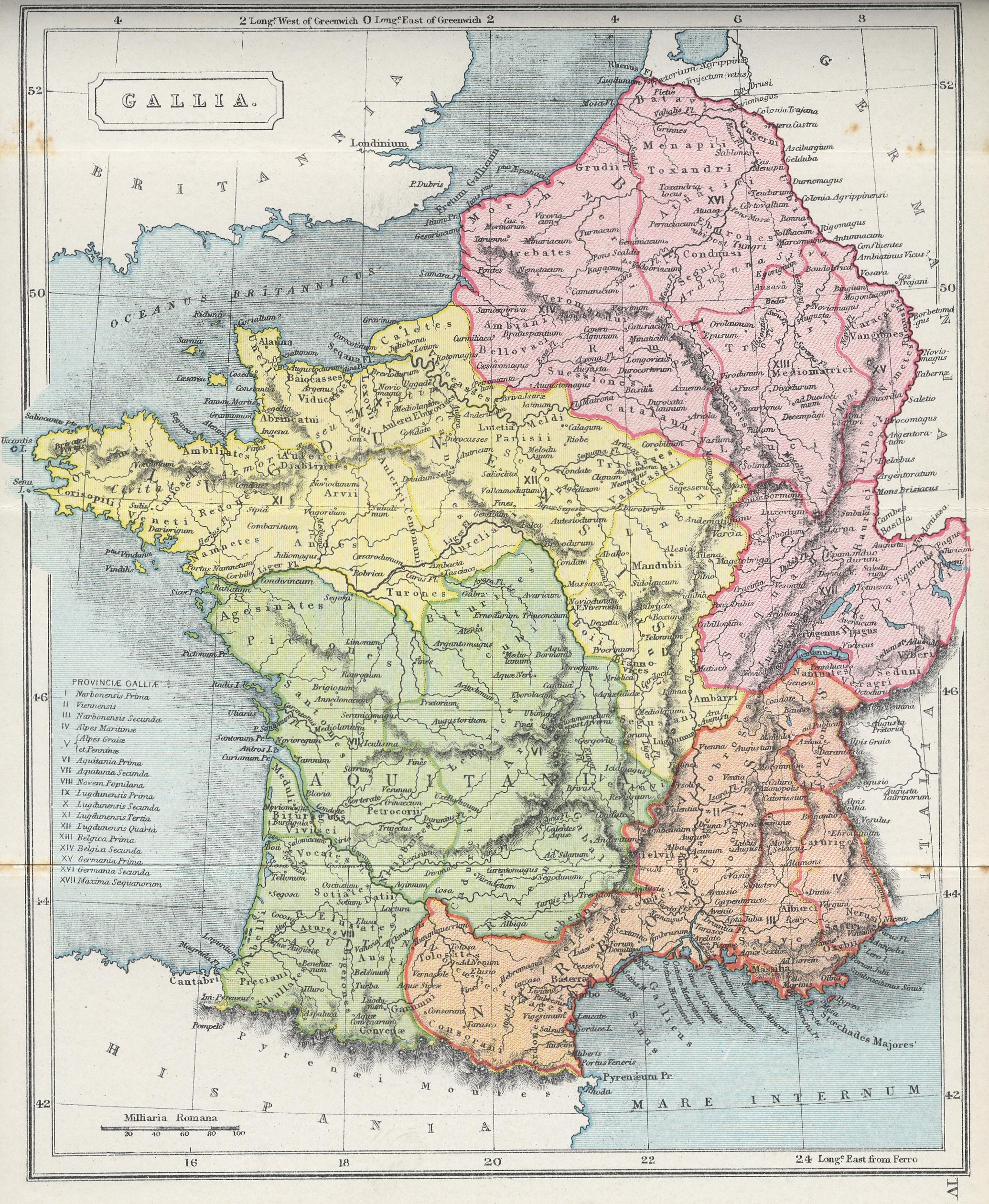
A. Map of the Northern part of Gallia (about 100 AD) displaying the Belgae area and the respective tribes.
B. A google map displaying the most ancient ancestor of R-U152 members as analyzed by the Belgium DNA project, FT-DNA of others (y-search). Blue: no further subclading yet. Red/orange: L20+. Yellow: L2+, Z367+, L20*. Pink: Z36+, Purple: U152*
C: Relative spatial distribution of the R-U152 community in the Belgian area.


(1) The regional results can be summarized as follows (North Sea >>> Germany):

West Flanders: U152 = 14 (10,8%)
East Flanders: U152 = 13 (12,3%)
Brabant : U152= 47 (9,3% of 507 samples in total)
Limburg: U152= 7 (10%)

Based on these results, no clear U152 gradient could be detected.

(2) For each member, a genealogy has been included and most date back to the early 17th century or even further back in time. Typically, only a limited number of close DNA relatives (GD 6 or less) were found in the Belgian U152 community, as compared to the other haplotypes.

One of the questions which raised into my mind is whether further subclading of the Belgian U152 community using L20, L2, Z36 etc. could link to the individuals to specific tribes such as the Menapii, the Nervii or the Eburones to mention a few? (ref 4) In addition, will an understanding of the U152 subhaplotype in Belgium/low countries - due to its high resolution at a microlevel- also contribute to understanding R-U152 migration patterns as a whole?

European cousins of Dierick van Roucourt 

Currently, the cousins of Dierick van Roucourt, born in the Halen region (Belgium), are 16 R-U152 members which belong to the Z36+ group (R-U152 FT-DNA). This group is now officially integrated into the ISOGG haplotree 2011 as subhaplotype R1b1a2a1a1b3d (weblink). The geographical distribution of Diericks' ancient cousins across Europe is displayed hereafter. Major archeological sites in Switserland (La Tène period: 500 BC-0) and Austria (Hallstatt period: 1000-500 BC) are also depicted.


Z36+ in Europe weergeven op een grotere kaart

By using the TMRCA calculations as described by Janzen (ref 5), the current age of the Z36+ point mutation is estimated at 3500 years before present (+/- 500 years, as of December 2014). In the near future, more samples will be analyzed which may further shed light on the distribution of this U152 subclade with a most likely origin in the Hall Statt culture (1000 - 500 BC).

Citations

Ref 1: DNA Belgie. DNA-Project 2010, Belgium excluding the Duchy of Brabant. Marc Van den Cloot et al (Lier, 2011). ISBN 978 90 804 30 525.
Ref 2: DNA Brabant. DNA-Project 2009, Duchy of Brabant. Marc Van den Cloot et al (Lier, 2010). ISBN 978 90 804 30 501.
Ref 3: Part of GALLIA, from "The Atlas of Ancient and Classical Geography".The Project Gutenberg
Ref 4: De Oude Belgen (The ancient Belgians). Udo Janssen (The House of Books, 2007). ISBN 978 90 433 08 662
Ref 5: Instructions for use of the linked Excel spreadsheet to calculate ages of subclades using the variance method. Tim Janzen MD.  http://www.timjanzen.com/dna.html

woensdag 25 mei 2011

Are the Recourts Belgian Celts?

In this blog, results of the y-chromosomal SNP - and STR markers are discussed. Both independant types of DNA markers may suggest that the paternal line of the Recourt family is of Celtic origin, providing that the biological - and paper trail coincide (last update August 19).


On the origin of SNP U152

To further explore my Belgian roots, I decided to include a "deep clade haplotyping" in my DNA profiling at Family Tree DNA. My Y-chromosome appears positive for the so-called U152 point mutation or SNP (Single Nucleotide Polymorphism).


Apparantly, there seems a correlation between SNP U152 and certain STR values (also 492, YCA). Therefore, I included an overview of all my ysearch.org STR (short tandem repeats) values.  Please find here the ongoing U152 subhaplotyping webpage of FT DNA. I am currently in Group 1 which can be characterized as "U152 + DYS 492=12".


There is a U152.org website, a FTDNA group and a DNA forum related to this specific R1b-SNP.  Interestingly, based on current results, a migration pattern of U152 could be established (source rrocca).


It seems that SNP U152 has its single origin somewhere near the Alps and while reading the discussions at several websites, it may have co-migrated with the the Hallstatt and the succeeding La Tene culture with its origin in South Germany/ Switserland. This discussion postulates that the U152 mutation has it roots about 3500 BC. The overview of David Fallaux suggests that the U152 "G to A" nucleotide transition may have occurred at a male forefather even further back in time (source). Further discussions can be found here, also indicating that ancient DNA would be required to correlate U152 with a (proto)Celtic culture.

Y-STR diversity within subhaplogroups - fylogeography: U152 is 7000-10.000 years old.

An interesting approach towards the age of U152 is described in the DNA Brabant project 2009 (Marc Van den Cloot ed., ISBN 9789080430501, 2010). By using subhaplogroups with more than 15 Belgian members, the STR variation was determined. Within a subhaplogroup fast- and slow mutating  STRs could be determined. Assuming a constant molecular clock, tMRCA's were estimated (time to Most Recent Common Ancestor) using the ASD-method (Behar et al, 2003).This method calculates the differences between the observed haplotypes as compared to the MRCA ("ancestor") haplotype. The ancestor haplotype was reconstructed by using the most frequent value of the STRs. According to these calculations, the U152 origin lies between about 7000 to 10.000 YBP (assuming 25 or 35 years/generation).


Recent Ancestral Origin: Switserland (protoCeltic?) 

I also screened my 67 STR values using the Recent Ancestral Origins mode at the FT-DNA site, which contains more than 200.000 DNA samples. Apparently, the frequency of exact matches for 12 markers is the highest for Swiss members: 47 out of 1775 = 2,6%. Unfortunately, there are no exact matches at higher levels of STR markers yet, while 3 samples (England/Ireland) mismatch one marker at the 25 STR analysis.

The site states that percentages above 2 may be considered as significant. While checking for exact 12 STR matches at members of other countries, elevated frequencies can also be found in Scotland (2,3%), Wales (1,9%) and France (1,9%) .


This personal STR-12 frequency map may correlate with the Northern migration pattern of the Celts from about 900 to 300 BC. The Celtic roots are in the Hallstatt/ La Tene culture, as displayed in the simplified map hereafter.


Subgroup 1 (U152)

In addition, the migration of the U152 Group 1 to which I belong seems to follow the Northern Celtic route. The data have been graphically visualized by the Family Tree DNA Company and the relevant part is shown hereafter. (my compliments for all these accessible analyses of Tibor Fehér and colleagues, which - in my view- make the difference with other genealogy DNA companies).


Currently, my presumed Roechout forefather originating from Sint-Truiden (yellow balloon in map above) is the only Belgian member of group 1 sub U152 (L2-, DYS 492=12). He may possibly connect the Swiss-German (Rhine?) migration with the United Kingdom members. My paper trail suggests that the paternal line of the Roechout family (1400 AD) came from the Brussels area (Boechout, Crayenem 1100 AD) and further back in time possibly even from more westwards? Four Belgian- and 3 Dutch FT DNA members are in other U-152 "L2+" groups. According to Jafety in this DNA forum discussion, based on present knowledge, the L2 SNP has evolved at about 2000-1200 BC and has its origin in Southern Germany, near the Rhine. Does this mean that the L2- group 1 migrated earlier to the North? Ofcourse, the migrating (proto)Celtic tribes could also have consisted of a mixture of L2+, L2- and other families. In this respect it is also important to realize that no 100% correlation exists between the Celts and SNP U152, and further subclading of U152 may reveal more insights (T. Fehér).

When screening at the YHRD database (> 90.000 deposits) using 13 STR values and SNP U152, a 100% match with five members appeared. Two of them are located in the Belgian Brabant area (n=124, 1.6%) one member in the Dutch Brabant area (n=117, 0.85 %), one in the Belgian Antwerp area (n=233, 0.4%) and finally one member in Germany (n=131, 0.75%). The data of the Duchy of Brabant DNA project are deposited in the YHRD database.

Does this mean that the Recourt forefather is of Belgian Celtic origin? I will await any further SNP extension sets, which may render more insight . Please also view this map displaying that, during the Roman period, the Northern Belgian / Southern Dutch (below river Rhine) inhabitants consisted of a mixture of Celtic and German tribes. And finally, the work of David Fallaux concerning the Belgae - England connection.


Update August 8, the first novel commercially-available U152 downstream SNP: Z36

New SNPs downstream of U152 are becoming available at the FTDNA company using the "advanced tests mode". Yesterday, I ordered the first new Z36-SNP analysis, as suggested by another DNA forum member. We will wait and see what the results will be ...

Update August 19: Z36+ !!!

Yes, my Y chromosome is positive for SNP Z36 and I moved to a novel U-152 subclass "3". The Z36 group now consists of 5 members and is growing (Ireland, France, Swiss, Belgium, Italy). There are more novel SNPs under development, so the story will continue.  Please check the proposed novel U-152 phylogeny.
You can actually see the position of the Z36 point mutation at the y-chromosome map of Thomas Krahn. It is positioned on the short arm of the Y-chromosome at about 5 Mbp (5.021.118 bp to be precise). When clicking on the word "Z36" below, additional info is shown. It is a "A to G" point mutation and you can even read which forward and reverse primers are used in the PCR reactions to detect it. It is stated downstream of U152* but has not been  listed in the ISOGG haplogroup tree yet.


Update September 15, R-U152 distribution in the low countries

Please find below a first compilation of  R-U152 members in the low countries, extracted from the Brabant-Belgium (mostly Flemish) DNA project, Y-search and FT-DNA.


Blue: R-U152, non-determined subclades yet
Yellow: R-U152, subclade L2+, Z367+, L20*
Orange: R-U152, subclade L20+
Pink: R-U152, subclade Z36+
Purple: U152* (L2-)

***

zondag 6 februari 2011

Genetic Genealogy III

Y chromosomal DNA results: Ancestry and Family Tree DNA.


1. Ancestry

The results of the Ancestry Y-46 test arrived by email at February 1. A first comparison with the Ancestry database displayed most similarities with US(not shown) and UK members. In addition more distant relations appear in the South of Germany and Ireland (see map below).


However, data comparison appeared on a limited number of markers, while the number of DNA members may be relatively low. I therefore decided to manually compare the data using http://www.ysearch.org/, which is a service of the Family Tree DNA company.

I used a stringent setting, comparing at least 36 DNA markers. At the top row, the values of my "Single Tandem Repeats" or STRs are displayed, while the next rows display the variations when compared to the top 6 (43 markers).  For each marker, the absolute variation is shown and summarized in the first row (grey).


Note: the following Ancestry.com markers were adapted according to YSearch:

Dys 441: Ancestry result = 14 >>> Ysearch = 13
Dys 442: Ancestry result = 17 >>> Ysearch = 12
Y-GATA-A10: Ancestry result = 15 >>> Ysearch = 13
Y-GATA-H4: Ancestry result = 12 >>> Ysearch = 11

Interestingly, the top 3 are the Belgeri family, descending from the Northern part of Italy closeby Switserland (Como area). The STR variations are between 9 and 11. Next to these, the families Griffith (London), Whalen (Ireland) and Staples (York, USA) also display a total variation of 11. All of these members were tested as being a member of Haplogroup/subclade R1b1b2a1b. However, clearly these families are not closely related ....


Haplogroup R1 subclade b1b2a1b, branching through Northern France/ Belgium towards the UK and Ireland? 


The map above (source) displays the most likely path the R1b subclade has travelled. Apparantly, a "b-subclade" branched towards Belgium/Northern France and crossed the North Sea at its narrowest passage at Calais towards the South of England and finally Ireland. This b-subclade also closely passed the Alpes and further branched towards the Northern Part of Italy about a 1000 years later.

These passages coincide with my first ancestors (See star: Brabant or Limbourg), displaying highest similarities with Nothern Italian, UK and Irish members. I now also better understand the results obtained by the Ancestry mapping. However, relationships appear to date back to at least 4000 years, which correspond with about 100-150 generations. But why aren't there any high similarities with Belgian members yet? Possibly, I need to practice the settings more into detail. I will wait for the results of the Family Tree Y-67 analysis before further interpretations.


2. Family Tree
During March, additional Y chromosomal STR results were received from Family Tree DNA. Please find below all 76 Dys values, which can also be found here. Unfortunately, there are no high homologies, when comparing with both the Ysearch - and FTDNA databases.


Michael Roekaerts, originating from Belgium Brabant, compared his DYS results. The homology appears very limited however, which is a pitty since the name Roekaerts is one of the presumed family name variations. When checking the distribution using http://www.familienaam.be/, there may however be several non-related Roekaerts families, either origination from Limburg, Brabant or the French-speaking Wallony (see map below).


Similarly, several independant Roucourt families can be discriminated, from which it has been proven that only the Limburg family is indeed related to the Dutch Recourt family. Please check the Roucourt (and Rocourt) name distribution below. 


So, I will need to search and contact the "Sint-Truiden Roekaerts" family to investigate a possible relationship.


zondag 9 januari 2011

Genetische Genealogie 2: testkits van Family Tree en Ancestry

Beide Y DNA sampling kits zijn gearriveerd. De kit van Family Tree DNA arriveerde op 7 januari 2011 (verzonden op 16 december) en de kit van Ancestry kwam op 8 januari (verzonden op 13 december). Ik had net een dag of wat daarvoor een maitje gestuurd, waarbij Ancestry aangaf dat de kit vaak wat langer bij de douane kan zijn, dus svp nog 7-10 dagen wachten. Totaal kan het dus een maand duren, maar de kerstdagen etc zitten er tussen.

Family Tree DNA kit

Een Y-67 kit aangevraagd die bestaat uit 3 swab kits en 3 met vloeistof gevulde plastic flesjes.


Op de foto hierboven zie je nog 1 schraper verpakt en twee flesjes zijn al gevuld. Minimaal 4 uur tussen het schrapen en de handleiding is duidelijk.


Ik ben gestart op vrijdagavond, vervolgens zaterdagochtend en zondagochtend voor het eten en drinken, zoals aangegeven. Het zijn echte schrapertjes, maar pijnloos. De eerste kwam wat lastig uit de verpakking, het bovenste gedeelte de schraper liet los en er weer voorzichtig opgeduwd zonder aan te raken. Bij de andere twee eerst de verpakking langszij helemaal opengeknipt.

Alle 3 de monsters in de retourenveloppe inclusief het ingevulde formulier (aangegeven dat ik al betaald heb) en het getekende groene "Release Form". Hiermee geef je toestemming -mochten er DNA overeenkomsten zijn- dat het emailadres wordt vrijgegeven. Heb ik geen probleem mee, graag zelfs want dat is toch de bedoeling, overeenkomsten vinden?


Blijkbaar bewaart Family Tree het DNA 25 jaar zoals aangegeven in de begeleidende brief.


Family Tree DNA heeft zijn eigen laboratoriumfaciliteiten en personeel. Een gecertificeerd laboratorium.


Ancestry DNA kit (Y-46)


 Principe is hetzelfde als bij Family Tree, met de volgende verschillen:

- Je kunt 3 samples op hetzelfde moment nemen. Wacht circa 30 minuten na je eten om verontreiningen te voorkomen (FT DNA, 60 minuten). Het zijn geen scrapers maar een soort wattenstaafjes voor de binnenkant van de linker, rechter en voorkant van de binnenkant van je wang/mond. 30 seconden is voldoende (FT DNA 60 seconden). De staafjes gaan niet in een potje maar moeten ca 30 minuten drogen en dan in de enveloppe.
- Er worden 46 markers getest in plaats van 67.
- Er zit geen Consent Agreement bijgesloten, terwijl dit wel staat aangegeven
- Er zit een coupon bij waarmee je bij het postkantoor de frankering kunt regelen (maar die blijkt niet meer geldig)
- Er word aangegeven dat na ontvangst het maximaal 4 weken duurt voordat de testresulaten er zijn.

De testen van Ancestry.com worden uitgevoerd door Sorenson Genomics, ook een gecertificeerd laboratorium.


Family Tree of Ancestry, welke is beter?

Te vroeg om daar iets over te zeggen. Ik zal deze sectie in de loop van de tijd updaten en nieuwe blogartikelen maken. Ik kan ook nog niet zeggen of de 67 DNA markers test van Family Tree meer informatie gaat geven dan de 46 DNA marker test van Ancestry. Op de Ancestry website lees ik het volgende:

"It's not as simple as -more markers equal better results-. After 45 - 50 markers, you would need a test consisting of 100 markers or more to significantly narrow the Most Recent Common Ancester range"

We zullen zien of deze zin klopt, zal blijken uit de resultaten en ik moet me dan nog wat verder in de theorie inwerken. De kosten van de FT 67 waren circa 20% hoger dan de Ancestry 46 kit.

wordt vervolgd

vrijdag 24 december 2010

Genetische Genealogie I : mannelijk Y-chromosomaal en vrouwelijk mitochondriaal DNA.

Het wordt tijd om een alternatieve benaderingen toe te passen om de afstamming van Roechout en Boechout te onderbouwen: Genetische Genealogie. Toevallig recentelijk via mijn werk een presentatie van het Genographic project gevolgd en de laatste jaren zijn er redelijk wat vorderingen gemaakt. Ik heb twee "Paternal Lineage" testen aangevraagd (Ancestry en Family Tree DNA). Waarom twee? Ik had net de test bij Ancestry besteld en ontdekte toen Family Tree DNA ..... Deze onderneming komt wat professioneler over, dus daar ook een kit besteld. Of het verschil er daadwerkelijk is moet nog gaan blijken, want ik maak er een soort vergelijkend warenonderzoek van, dan hebben anderen daar wellicht ook wat aan.


De testen zijn nog niet binnen (nu wel, zie boven de  "Family Tree DNA wang swap" van 8-1-2011), dus eerst maar wat theorie en dat ligt me goed omdat ik een moleculair-genetische achtergrond heb.


(A) Mannelijke voorouders: Y-chromosomaal DNA.


Chromosomen kaart


Ieder mens heeft in iedere lichaamscel een set aan genetische informatie (DNA) die opgeslagen is in 46 chromosomen (2 * 23). Van 22 chromosomen zijn er ieder twee paar en verder hebben vrouwen 1 paar X-chromosomen en mannen 1 X-chromosoom en 1 Y-chromosoom. Het plaatje hierboven is dus van een man. De X- en Y-chromosomen bepalen het geslacht van de nakomelingen zoals hieronder weergeven:


Dus het Y-chromosoom wordt doorgegeven aan de mannelijke lijn en kan gebruikt worden voor Genetische Genealogie als men de achternaam volgt. Voor het volgen van de moederlijn wordt de samenstelling van het mitochondriaal DNA (mtDNA) bestudeerd (zie verderop in dit blogartikel).
Zoals ieder chromosoom, bestaat het y-chromosoom uit twee "allelen" die met elkaar zijn verbonden (centromeer). Op ieder allel ligt een streng van (nagenoeg) identiek DNA dat in een helix is gewikkeld.


Er liggen een aantal genen op het Y-chromosoom die coderen voor bepaalde eigenschappen (zie figuur hierna). Deze genen blijven in de regel van generatie op generatie hetzelfde en worden niet gebruikt om genetische relaties vast te stellen.


Echter, tussen de genen liggen ook stukken DNA die niet coderen voor bepaalde eigenschappen en veranderingen in deze stukken DNA zijn wel toegestaan. Zie hieronder een overzicht van dergelijke DNA regionen op het Y-chromosoom. Het betreft  (i) "Short Tandem Repeats (STR)" en (ii) "Single Nucleotide Polymorfism (SNP)".


(I) Short Tandem Repeats (STR) en directe mannelijke verwantschappen (haplotypes)


STRs kunnen worden gebruikt om relatief recente verwantschappen (tot circa 2000 jaar) tussen mannelijke lijnen aan te tonen. Alhier de theorie (bron).


De afkorting "DYS" staat voor:  "DNA Y-chromosome Segment" en de afkorting "YSTR" staat voor "Short Tandem Repeats op het Y-chromosoom". Oftewel er zijn een aantalen regionen op het Y chromosoom (DYS) waar STRs zijn en die kunnen varieren tussen de mannelijke opeenvolgende generaties. Wat zijn Short Tandem Repeats?

Daarvoor is nog een stukje achtergrond nodig:

De genetische DNA code is opgebouwd uit vier bouwstenen. A, T, C en G. Met deze 4 elementen kan alle genetische informatie worden gemaakt. Bij "genen" wordt een combinatie van 3 bouwstenen een "codon" genoemd. Zo is het codon ATG het signaal voor de start van een gen en TAG het signaal voor de stop van een gen. Een gen dat codeert voor bijvoorbeeld de oogkleur ziet er dus alsvolgt uit.

Structuur van een gen:  ATG-codon1-codon2-codon3-codon4-codon(n) - TAG

Tussen genen liggen er dus DNA fragmenten die niet belangrijk zijn en dat kunnen bijvoorbeeld korte repeterende elementen zijn.

Short Tandom Repeats:  GATA-GATA-GATA-GATA-GATA-GATA-GATA-GATA-GATA-GATA-GATA

Blijkbaar kan het aantal repeterende elementen (in dit geval als voorbeeld GATA) variereren tussen opeenvolgende mannelijke generaties. Dat komt omdat er GATA fragmenten kunnen worden toegevoegd (duplicaties) of kunnen worden verwijderd (deleties). In het hierboven aangegeven voorbeeld betreft het 11 repeterende GATA eenheden op een specifieke DYS locatie. De repeterende STR eenheid noemt men ook wel een "allel".

Indien je 2 mannelijke individuen met elkaar vergelijkt, dan kun je dus uitspraken doen over een mogelijke verwantschap. Zie de tabel hieronder als voorbeeld:


Boven in de tabel staan dus een aantal regionen op het Y-chromosoom waarin variaties optreden in het aantal repeterende eenheden (DYS 393, DYS 390, etc). Het aantal repeterende eenheden (allelen) is onderzocht voor 2 individuen. Mr. Bricker 2 en Mr. Bricker 3. Voor de meeste DYS locaties blijkt het aantal allelen hetzelfde. Zo hebben beide Brickers 13 allelen bij de DYS locatie 393, oftewel er zijn in beide gevallen 13 repeterende eenheden van specifieke DNA fragmenten (bijvoorbeeld 13*GATA). Er is maar 1 afwijking bij DYS 439: Mr. Bricker 2 heeft 13 repeterende eenheden en Mr. Bricker 3 heeft 12 repeterende eenheden. Er hoeft dus slechts 1 deletie op te treden en er is dus goede kans dat beiden nauw verwant zijn. In de regel geldt dat hoe meer DYS locaties hetzelfde zijn en hoe meer DYS locaties zijn getest, de groter de kans op directe verwantschap.

Ter illustratie ook twee naamgenoten Mr. Bricker die zeer waarschijnlijk helemaal niet / veel minder verwant zijn:


Zie ook deze pagina voor achtergrond informatie in het Engels:  http://blairdna.com/dna101.html


(II) Single Nucleotide Polymorfisme (SNP), evolutionaire haplogroepen en subclades.


Een tweede manier om mannelijke verwantschappen te onderzoeken zijn de SNP oftwel puntmutaties (veranderingen) op specifieke plaatsen van het Y-chromosoom. Zo kan een DNA element A in een T veranderen of een DNA element G in een C doordat er tijdens de duplicatie van het DNA een fout door het enzym DNA polymerase wordt gemaakt en deze fout wordt niet goed hersteld (wat meestal wel gebeurd).

Blijkbaar treedt de SNP variatie veel minder vaak op dan de hierboven beschreven STR variatie. Dat wil zeggen dat SNPs worden gebruikt om de wereldbevolking in specifieke groepen in te delen met als oorsprong Oost Afrika, zo'n 200.000 jaar geleden. De STR variaties beschrijven verwantschappen tot circa 2000 jaar geleden (zie ook Genebase  en de presentatie in het Engels).


Een aantal van de specifieke puntmutaties die voor het bepalen van Haplogroepen worden gebruikt staan in onderstaande tabel. Ze zijn dus door verschillende laboratoria ontdekt (bron).


Er zijn momenteel 20 haplogroepen die met een letter zijn genummerd. De indeling van de groepen is bi-allellisch, dat wil zeggen een DNA bouwsteen kan van A naar T veranderen (en andersom) en van G naar C (en andersom). Zie de figuur hieronder (bron).


Binnen de haplogroepen kan een verdere onderverdeling worden gemaakt, bijvoorbeeld met behulp van STR makers (zie hierboven). Men spreekt dan van "subclades".  Een gedetailleerde haplogroepkaart vind je ook op de website van Family Tree DNA (pdf downloaden duurt even).


Met behulp van de haplogroep indeling kan het verspreidingspatroon van de mensheid over de wereld in kaart worden gebracht.


en ook de verdeling van de respectievelijke haplogroepen over bijvoorbeeld Europa (bron).


R1b (rood) is dus de meest-voorkomende haplogroup in Zuid- en West Europa. Deze grote groep kan dus worden onderverdeeld in subgroepen ("subclades").  
 
(III) Y-Chromosoom DNA sequencing.
 
 
Sinds medio 2012 is ook mogelijk om de volledige DNA volgorde van een groot gedeelte van het Y-chromosoom te laten bepalen. Met een zgn. (next generation) DNA sequencer wordt dan de volgorde van de DNA bouwstenen bepaald bijvoorbeeld: A-T-C-G-G-A-A- enzovoort. Er kunnen dan in één keer een groot aantal STRs (I) maar vooral SNPs (II) bepaald worden. Het deel van het Y-chromosoom waarvan de DNA sequentie is geanalyseerd, wordt namelijk opgenomen in een database. Het DNA wordt vergeleken met het 'standaard Y-chromosoom', zodat jouw specifieke mutaties kunnen worden vastgesteld.   
 
Hieronder is een schematische weergave van het Y-chromosoom weergegeven inclusief het gedeelte van het Recourt dat in 2013 is gesequenced bij de firma Full Genome Corporation (https://www.fullgenomes.com). Er is van circa 20 Mbp (20 miljoen DNA baseparen) de volgorde bepaald en vergeleken met de database van bestaande en nieuwe SNPs. De verspreiding van de specifieke Recourt mutaties is als blauwe balkjes weergegeven.     


Hieronder is de lijst van nieuwe "private" SNPs op het Y-chromosoom vermeld. De notaties kunnen alsvolgt worden gelezen.
 
kolom 1: positive van de mutatie op het standaard (b37) y-chromosoom
kolom 2: de waarde van de base op het referentie y-chromosoom (A,T,C of G)
kolom 3: de waarde van de base op het Recourt chromosoom: de mutatie of private SNP
kolom 4: de naam van de mutatie FGC staat voor Full Genome Corporation


De ruwe data van de Y-chromosoom analyse wordt opgeslagen in een zgn. .BAM file. Dit is een zeer groot bestand (enkele GB), dat ook gebruikt kan worden bij andere analyse sites. In mei 2014 is de Recourt.BAM file geanalyseerd door www.yfull.com.   De Y chromosoom analyse resulteert in een complete weergave van de gevonden (gemeenschappelijke en prive) SNPs, STRs en ook het mitochondriale DNA (B, zie hieronder).


Y-chromosomale analyse kan ook bij FT-DNA worden uitgevoerd. Daar heet deze service "BigY". De analyse is goedkoper, maar er wordt ook minder DNA gesequenced.  Voordeel is wel dat de analyse wordt opgenomen in de FT-DNA database, maar daar komen dus meer alternatieven, zoals YFull.
  
Full Genome Corporation:  analyse ca. 20 - 25 Mbp, prijs medio 2014  $999,- (€ 750)
Family Tree DNAL analyse ca. 10 Mbp, prijs medio 2014 $695,- (€ 520 regelmatig aanbiedingen).
 
Mijn verwachting is dat de prijzen verder zullen dalen, omdat de DNA analysetechnieken steeds goedkoper worden.
 
  
 (Zie ook Cruwys news)
 
 
Y-DNA Databases

Voor genealogische onderzoek komt het natuurlijk aan op de database zodat je de gegevens kunt vergelijken met reeds ingevoerde gegevens. En ik was er al bang voor: er zijn er meer dan een en ik weet nog niet of ze allemaal compatibel zijn (hetzelfde format accepteren), gekoppeld, publiek etc zijn. Zie hier een overzicht waar ik nog niet in detail naar gekeken heb: http://freepages.genealogy.rootsweb.ancestry.com/~gkbopp/DNA/YBases.htm


(B) Vrouwelijke voorouders: mitochondriaal DNA.


De samenstelling van het mitochondriaal DNA (mtDNA) is geschikt voor het volgen van de vrouwelijke genetische lijnen. Dit mtDNA wordt namelijk specifiek door de moeder overgedragen.


Bij de bevruchting versmelten de mannelijke zaadcel en de vrouwelijke eicel (bron). Zie de figuur hierboven (als je erop klikt wordt deze vergroot) en de toelichting hierna.  

De mannelijke zaadcel bestaat uit een celkern met 23 (haploide) chromosomen bestaande uit 22+X of 22+Y chromsomen. De zaadcel bepaald dus het geslacht van de nakomeling (zie ook hierboven). 
De vrouwelijke eicel bestaat uit een kern met 23 chromosomen (22+X = haploide) met daarom het cytoplasma waarin zich ook mitochondrien bevinden. Mitochondrien zijn eigelijk de energiefabriekjes van de menselijke cellen ("ATP" productie). Bij de mannelijke zaadcellen bevinden deze zich aan de staart en zorgen voor de energie die nodig is voor de voortbeweging van de zaadcellen.

Nadat de eicel en de zaadcel zijn versmolten bestaat de bevruchte eicel dus uit:

(1) een celkern met 23 chromosomen van de vrouw en 23 chromosomen van de man.
(2) cytoplasma afkomstig van de vrouw waain zich ook de mitochondrien van de vrouw bevinden.

In de mitochondrien bevindt zich mitochondriaal DNA (mtDNA) dat dus wordt overgedragen van de vrouwelijke stammoeder (n) naar de vrouwelijke en mannelijke nakomelingen (n+1). En dan weer van de vrouwelijke (n+1) generatie naar de vrouwelijke en mannelijke nakomelingen (n+2). Zie ook de figuur hierna (bron).


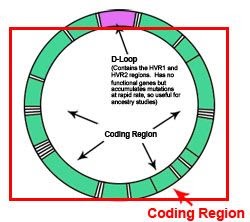
Het mt DNA is circulair en een groot gedeelte van deze cirkel bevat genen die zeer geconserveerd van generatie naar generatie worden overgedragen (zie figuur hieronder). Het betreft oa. het ATP synthase dat codeert voor een enzym betrokken bij de energieproductie (donkerblauw). Mutaties (SNPs) zijn dus zeer zeldzaam, maar komen wel voor en worden ook gebruikt voor het bepalen van mtDNA haplogroepen.


Er is ook een gedeelte dat niet codeert voor genen en mutaties komen veelvuldig voor. Het betreft de HyperVariabele regionen HV1 en HV2, bovenin de cirkel.


mtDNA analyses: HV1, HV2 en coderende regionen.


Het circulaire mitochondriaal DNA (mtDNA) bestaat dus uit 3 regionen (bron):

- Hypervariabele regio HV1
- Hypervariabele regio HV2
- Coderende regionen


Blijkbaar is een combinatie van een analyse van de niet coderende HV1, HV2 regionen en een aantal SNPs in het coderende gedeelte nodig om de oorsprong van het mtDNA te kunnen vaststellen (haplotyperingen). Vergelijkbaar bij de Y-chromosomale typering, zijn er een groot aantal maternal (26) haplogroepen gekarakteriseerd. 


De basis haplogroepen worden vastgesteld dmv de SNP genotypering in de coderende regionen:


Terwijl de respectievelijke subgroepen ("subclades") kunnen worden bepaald met behulp van de DNA analyse van de HV1 (400 bp) en HV2 regionen. Een gedetailleerde kaart staat op de website van Genebase.

Net als bij Y-chromosomaal DNA kunnen de verspreidingspatronen van de respectievelijke mtDNA haplogroepen over de wereld in kaart worden gebracht. Ook hier ligt de basis in Afrika.


En tenslotte een onderverdeling voor Europa (bron):


mtDNA Databases

En ook hier een overzicht waarop verschillende mtDNA databases staan vermeld. Ik heb ze nog niet gecontroleerd:


***